Two young workers went to work on the 48th floor of a Mumbai high-rise and never came home. Their deaths are another reminder of why the safety profession exists, and what it costs when basic controls are missing.
The Incident
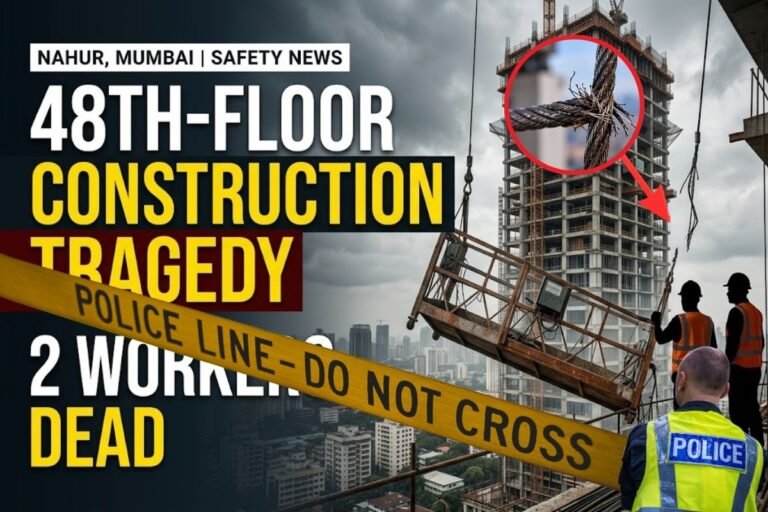
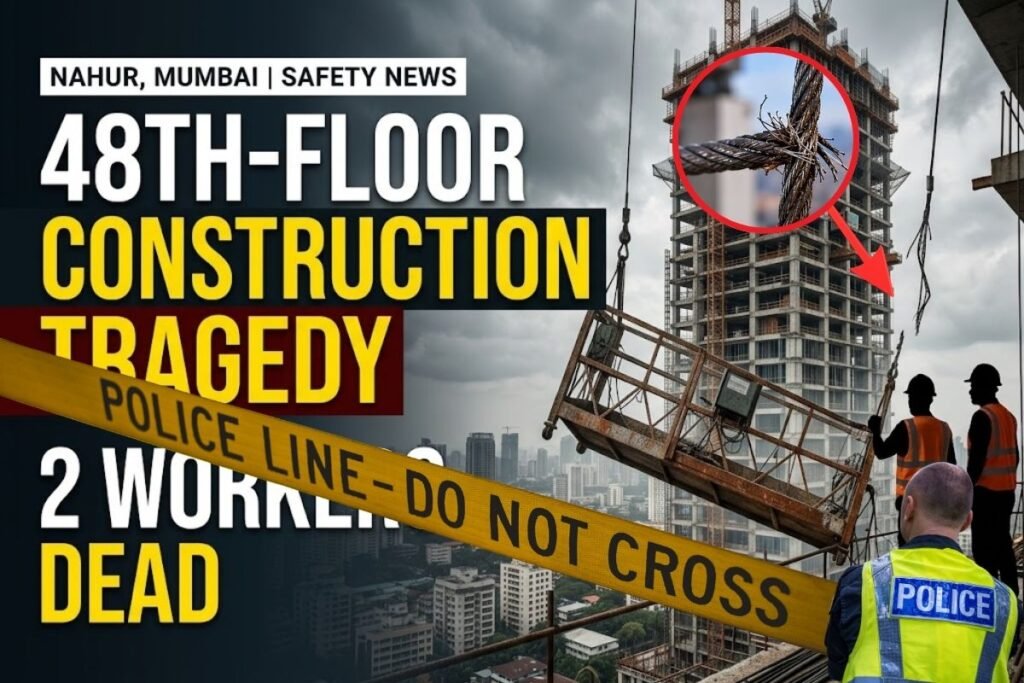
On October 10, 2026, Saif Ali (21) and Mohammed Suhaib (31) died when a suspended platform (cradle) tilted after a supporting cable snapped. They were working on the 48th floor of the under-construction Senroof Project of Pioneer Housing Society on Airoli-Bhandup Road, Nahur, Mumbai, installing lights on the exterior of the building’s galleries.
Three workers had finished electrical work on the 47th floor and moved up to the 48th. A cable on one side of the cradle snapped, and the platform tilted sharply. The two victims were still putting on their safety belts and had not secured them, so they fell. The third worker, who had fastened his belt in time, survived.
Preliminary Root Causes
Immediate cause: Failure of a supporting cable on one side of the cradle.
Why it proved fatal, according to police findings:
- Workers had not secured their safety belts before the platform moved.
- Protective safety netting and other fall-prevention safeguards had allegedly not been installed.
- The supervisor was expected to ensure belts were worn before the platform was operated or descended, but allegedly gave no instructions.
- Responsibility was split. The workers were employed by an electrical contractor, while a separate firm was responsible for maintaining the cradle.
Source: freepressjournal
Navghar police registered a case of causing death by negligence under the Bharatiya Nyaya Sanhita against the contractor’s owner, the site supervisor, the maintenance firm’s representative and other concerned persons.
Probable underlying causes (professional analysis, not confirmed by investigators):
- Inadequate inspection and maintenance of wire ropes and the cradle
- No “tie off before boarding” rule
- Weak supervision and no stop-work culture
- Unclear accountability between the main contractor, sub-contractor and maintenance agency
A wire rope that parts suddenly usually carries a history of wear, damage or overloading that earlier inspections could have caught.
Similar Accidents in India and Around the World
| Location | What Happened | Parallel to Nahur |
|---|---|---|
| Thane, India (August 2023) | A crane collapsed above an under-construction expressway near Mumbai, killing at least 20 workers. | Lifting equipment failure on a construction site. |
| Noida, India (September 2024) | Two workers fell when wooden beams supporting an overhanging eave on the third floor collapsed. | Two workers falling from a temporary structure. |
| Dubai, UAE (November 2010) | Two Indian workers, aged 24 and 27, fell from the 27th floor while installing glass after their cradle reportedly suffered a mechanical failure. One source reported that a winch had failed. | Cradle failure involving two workers who were Indian nationals. |
| Sharjah, UAE (2010) | Four workers died after falling six storeys in a cradle accident. It was unclear whether they were wearing safety harnesses. | Cradle-related fall; uncertainty regarding the use of safety harnesses. |
| Fort Lauderdale, USA (April 2024) | A support cable failed on a platform used to raise a tower crane. One worker, who was tied off, was rescued, while another fell approximately 30 storeys and died. OSHA found that two contractors could have prevented the incident. | Support cable failure; fall protection made the difference between survival and death. |
| São Paulo, Brazil (October 2023) | A scaffolding collapse between two 33-storey towers killed one worker and left others suspended from ropes or cables approximately 500 feet above the ground. | Failure of access equipment while working at extreme heights. |
| Dhaka, Bangladesh (Date not specified) | Two workers fell from scaffolding at a 14-storey building after a rope snapped. | Rope failure involving two workers working at height. |
The pattern is clear. Equipment fails, and what separates survivors from victims is whether the worker was tied off to an independent lifeline.
Key Safety Measures
- Tie off before you board. Make 100% tie-off to an independent lifeline mandatory before anyone steps onto or operates a suspended platform.
- Inspect and certify equipment. Check wire ropes, winches, safety locks and overload devices daily, backed by third-party certification and maintenance records.
- Install physical barriers. Use safety nets and edge protection so harnesses are not the only defence.
- Plan the work. Use a Permit-to-Work system, Job Safety Analysis and a documented pre-shift briefing that includes a tie-off check.
- Name one accountable party. The principal employer should have overall responsibility, with clear duties for sub-contractors and maintenance agencies.
- Supervise competently. Supervisors need training and real authority to stop work.
- Prepare for rescue. Have a tested plan for suspended workers, including trained rescuers and awareness of suspension trauma.
- Report near misses. Frayed ropes, tilting platforms and bypassed locks are warnings that should reach management.
What This Means for Your Safety Career
- Technical competence builds credibility. Qualifications like NEBOSH, IOSH or an industrial safety diploma open doors. Knowing how a cradle is inspected, what a sound anchorage looks like and how rescue works earns respect on site.
- Be the person who can say “stop.” Halting work under deadline pressure is the hardest part of the job. Speak calmly, firmly and with facts.
- Look beyond paperwork. Permits and checklists mean little if no one watches the work. Verify controls in practice, talk to workers and question assumptions.
- Follow the chain of responsibility. The Nahur case shows how divided contracts can leave dangerous gaps. Make sure someone owns each control.
- Learn from every incident. Study investigation reports and accidents from other sites and countries. Strong safety careers are built on curiosity.
The Bottom Line
No deadline, production target or commercial pressure is worth a worker’s life. Two workers fell because a cable failed and, reportedly, because the layers of protection that should have caught them were not in place. Every worker deserves to return home safely to their family.
Note: Incident details and causes are subject to official investigation. This article is intended solely for safety awareness and learning.