A toolbox talk (TBT) is only as valuable as the record left behind. You can deliver the best five-minute safety briefing on site, but if there’s no signed toolbox talk record sheet to prove it happened, it may as well not have. This guide covers everything you need: how to write and deliver a toolbox talk, what a proper toolbox talk record sheet should contain, ready-to-use templates, and a full list of toolbox talk topics and examples — for construction, general industry, and OSHA-aligned programs.
What Is a Toolbox Talk?
A toolbox talk is a short, informal safety meeting held at the worksite — usually 5 to 15 minutes — before a shift starts or during a break in work. It focuses on one topic at a time: a specific hazard, a piece of equipment, a recent near-miss, or a reminder about procedure. Unlike formal safety training, a toolbox talk is meant to be quick, relevant, and delivered close to where the work is actually happening.
The name comes from the idea of gathering the crew “around the toolbox” for a quick chat before picking up tools for the day.
Why the Toolbox Talk Record Matters
Delivering a toolbox talk without documenting it creates a gap that auditors, regulators, and insurers will notice immediately. A proper toolbox talk record:
- Proves due diligence if an incident is investigated
- Demonstrates compliance with OSHA, HSE, or WorkSafe requirements depending on your region
- Tracks which topics have been covered and which are overdue
- Confirms which workers attended, so nobody can claim they “weren’t told”
- Builds a searchable history of site safety communication (a toolbox meeting history)
- If it isn’t recorded, in the eyes of most regulators and courts, it didn’t happen.
- What Should Be Recorded in a Toolbox Talk Attendance Register?
This is one of the most searched questions on the topic, and the answer is fairly standard across industries and countries. A compliant toolbox talk attendance record should capture:
- Date and time of the talk
- Location or site/project name
- Topic discussed (specific, not vague — “Ladder Safety,” not “General Safety”)
- Name of the presenter/supervisor delivering the talk
- Names and signatures of all attendees
- Duration of the talk
- Key points covered (a short summary, not a transcript)
- Questions raised or issues identified during the talk
- Any follow-up actions assigned, with owner and due date
- Photos (optional but increasingly common — a photo of the gathered crew or the sign-in sheet itself)
If your current attendance register is missing items 8 and 9, that’s usually the gap that shows up during an audit — a talk that raises a hazard but has no recorded action item looks incomplete.
Toolbox Talk Record Sheet — Template Structure
Project :
Channel Partner :
Date, Time & Duration :
Location :
Gang & Leader Name :
Name of Trainer :
Contents Covered in Brief :
| Sr. | Name | Trade/ Department | PPE Usage | Signature |
| 1 | ||||
| 2 | ||||
| 3 | ||||
| 4 | ||||
| 5 | ||||
| 6 | ||||
| 7 | ||||
| 8 | ||||
| 9 | ||||
| 10 | ||||
| 11 | ||||
| 12 | ||||
| 13 | ||||
| 14 | ||||
| 15 | ||||
| 16 | ||||
| 17 | ||||
| 18 |
EPC Personnel Clients Personnel
Tip: Keep the “Key Points Covered” section to bullet points, not paragraphs. A record that takes two minutes to fill in gets used consistently; one that requires an essay gets skipped or backdated.
Digital vs. Paper Toolbox Talk Record Book

A paper toolbox talk record book is still common on smaller sites — it’s cheap, needs no app, and signatures are unambiguous. The trade-off is that it’s easy to lose, hard to search, and can’t easily be shared with a head office or auditor remotely.
Digital toolbox talk records (a shared spreadsheet, a safety app, or a simple form tool) solve the searchability and backup problem, and most now support e-signatures or photo capture of a physical sign-in sheet as a hybrid approach. If you’re running multiple crews or sites, digital records make it dramatically easier to spot which topics haven’t been covered in a while.
How to Write a Toolbox Talk
A good toolbox talk script follows a simple structure:
- Pick one focused topic. Don’t try to cover three hazards in one talk — pick the one most relevant to today’s work.
- Open with why it matters. Reference a real incident, near-miss, or upcoming task that makes the topic relevant right now.
- Explain the hazard and the control. What can go wrong, and what specifically prevents it (PPE, procedure, equipment check).
- Use plain language. Avoid regulatory jargon; talk the way you’d explain it to a new hire.
- Ask a question. Get at least one worker to respond — this confirms engagement, not just attendance.
- Close with the action. What should everyone do differently, starting today?
- Record it immediately. Fill in the toolbox talk record form before the crew disperses, while everyone is still standing there to sign.
How to Do a Toolbox Talk (Delivery Tips)

Writing the talk and delivering it well are different skills:
- Keep it under 10 minutes. Attention drops fast outdoors or before shift start.
- Stand where the hazard is, if possible — a fall-protection talk delivered next to the actual scaffold lands better than one delivered in a break room.
- Make it two-way. A monologue is a briefing; a toolbox talk should invite at least one question or comment.
- Rotate presenters. Letting experienced tradespeople lead occasionally increases buy-in versus always hearing from the same supervisor.
- Don’t skip the sign-in. Even a five-minute talk needs a signature — this is the step most often forgotten under time pressure.
Toolbox Talk List: Topics by Category
Below is a broad toolbox talk topics list organized by category, useful for building out a rotating annual schedule.
General & Workplace Safety
- Housekeeping and slip/trip/fall hazards
- Manual handling and lifting technique
- PPE selection and correct use
- Heat stress and hydration
- Cold weather work
- Fatigue and shift work
- Stress and mental health awareness
- Emergency evacuation procedures
- First aid and reporting injuries
- Situational awareness / “listening for danger” on site
Construction-Specific
- Working at height
- Scaffolding erection and inspection
- Excavation and trenching
- Crane and lifting operations
- Ladder safety
- Power tool safety
- Electrical safety and lockout/tagout
- Confined space entry
- Fire prevention on site
- Vehicle and plant movement (traffic management)
- Dust and silica exposure
- Noise exposure and hearing protection
- Asbestos awareness
OSHA Toolbox Talk Topics (US-aligned)
- Fall protection standards (29 CFR 1926 Subpart M)
- Hazard communication (HazCom / SDS)
- Respiratory protection
- Bloodborne pathogens
- Machine guarding
- Forklift and powered industrial truck safety
- Recordkeeping and near-miss reporting
UK / SSSTS-Aligned Topics
- CDM 2015 responsibilities
- Working at height (Work at Height Regulations 2005)
- Manual handling regulations
- COSHH (control of substances hazardous to health)
- Site inductions and permit-to-work systems
Australia / WorkSafe-Aligned Topics
- Working at heights (Code of Practice)
- Traffic management on construction sites
- High-risk construction work permits
- Electrical safety (isolation procedures)
Top 10 Toolbox Talk Topics (Most Requested)
- Working at height
- Manual handling
- PPE compliance
- Slips, trips, and falls
- Electrical safety
- Fire safety and evacuation
- Heat stress / hydration
- Ladder safety
- Hazard reporting and near-misses
- Scaffolding safety
Toolbox Talk Examples
Example 1 — Ladder Safety Topic: Correct ladder selection, 4:1 angle rule, three points of contact, inspection before use. Discussion prompt: “Has anyone had a near-miss with a ladder recently — what happened?” Action: Inspect all site ladders this week; tag and remove any damaged units.
Example 2 — Heat Stress Topic: Recognizing early signs of heat exhaustion, hydration schedule, buddy system for outdoor crews. Discussion prompt: “What are the warning signs you’d watch for in a coworker?” Action: Confirm water stations are stocked and shaded rest areas are set up.
Example 3 — Scaffolding Safety Topic: Daily scaffold inspection tags, load limits, guardrail requirements. Discussion prompt: “Who’s responsible for checking the tag before we climb today?” Action: Verify scaffold tag is current before shift start; report any missing tags immediately.
These short, single-topic formats work whether you’re in the UK, Australia, or under OSHA — the structure (hazard, discussion, action) stays the same even as regulatory references change.
Difference between TBT and PTW
No — a Toolbox Talk (TBT) and a Permit to Work (PTW) are two completely different documents that serve different purposes. Here’s the distinction:
Toolbox Talk (TBT)
A short, informal safety briefing (5–15 minutes)
Communicates a hazard, reminder, or lesson to the crew before/during work
Doesn’t authorize anyone to do anything
The record is just proof that the talk happened and who attended
Happens routinely — often daily
Permit to Work (PTW)
No — a Toolbox Talk (TBT) and a Permit to Work (PTW) are two completely different documents that serve different purposes. Here’s the distinction:
Toolbox Talk (TBT)
- A short, informal safety briefing (5–15 minutes)
- Communicates a hazard, reminder, or lesson to the crew before/during work
- Doesn’t authorize anyone to do anything
- The record is just proof that the talk happened and who attended
- Happens routinely — often daily
Permit to Work (PTW)
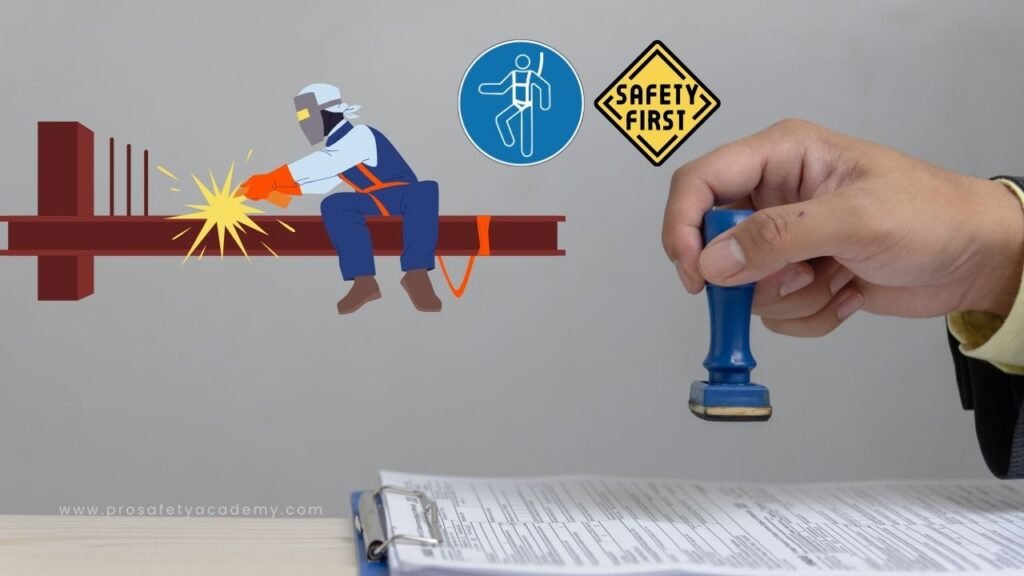
- A formal, controlled authorization document
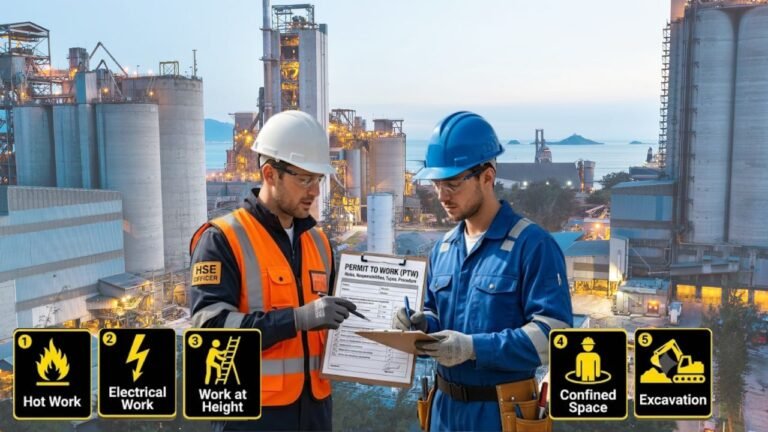
- Required before specific high-risk work can legally begin on that task (e.g., hot work, confined space entry, working at height, excavation, electrical isolation)
- Involves a sign-off chain — typically the worker, a supervisor, and sometimes a safety officer — confirming that hazards have been assessed and controls (isolations, gas testing, standby personnel, etc.) are in place
- Has a defined validity period and must be closed out when the work is complete
- No PTW = the work is not permitted to start, regardless of how well-briefed the crew is
How they relate in practice
They’re actually complementary, not interchangeable:
- A PTW is issued and signed to authorize a specific high-risk task.
- A TBT is often delivered as part of the permit process — briefing the crew on the specific hazards and controls listed on that permit before they start.
So you might see a PTW for “hot work on Level 3” that requires a toolbox talk on fire watch procedures as one of its precursor conditions. The TBT record and the PTW are still separate documents, though — one proves a briefing happened, the other authorizes the work itself.
If you’re building out content on this, “Toolbox Talk vs Permit to Work” could actually be a good companion article, since a lot of the same audience searching TBT record terms will also search PTW-related keywords. Want me to draft that one too?
FAQ
They’re often the same document. “Record” typically refers to the full form (topic, discussion points, actions), while “attendance register” can refer specifically to the sign-in portion. Most sites combine both into one sheet.
This varies by jurisdiction and company policy, but many organizations retain records for at least 1–3 years, and longer for projects involving high-risk work like asbestos or confined spaces. Check your local regulator’s specific retention requirement.
Yes — a signature (physical or digital) is the standard way to prove attendance and is usually expected by auditors and insurers.
Daily on higher-risk sites (like most construction projects), or weekly on lower-risk workplaces. The topic list should rotate so the same subject isn’t repeated too often.