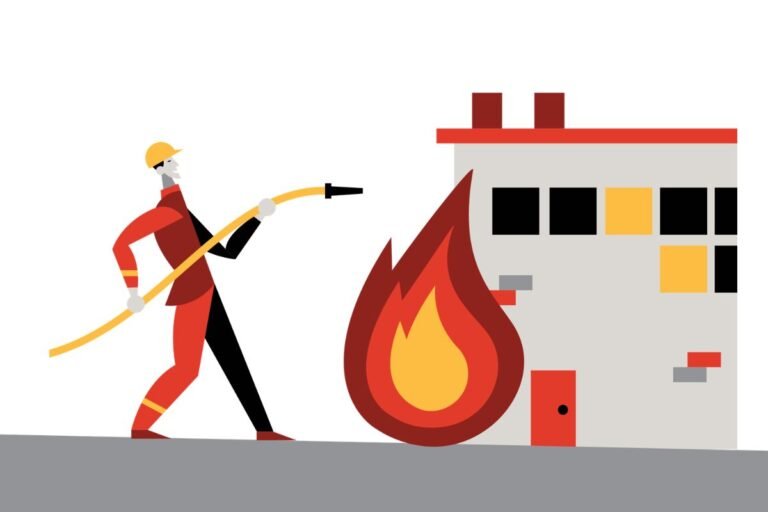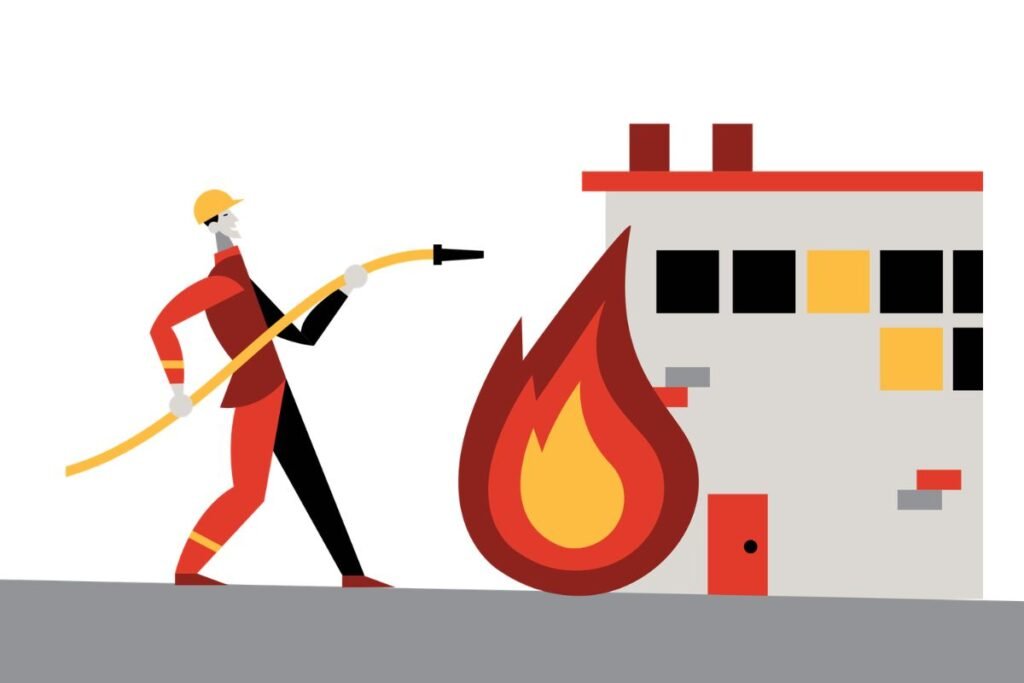
Fire hose nozzles are a vital part of firefighting equipment. They allow firefighters to control the flow, pressure, reach and spray pattern of water—or foam—based on the fire, location and tactical objective.
The right nozzle can help crews cool intense heat, protect escape routes, suppress flames efficiently and reduce risks for firefighters and people nearby. From a small building fire to an industrial incident, nozzle selection matters.
Common types of fire hose nozzles
| Nozzle Type | Main Function | Typical Use |
|---|---|---|
| Pistol Grip Nozzle | Uses a handle for easier control and handling | Structural firefighting and general hose-line operations |
| Ball Valve Nozzle | Opens or shuts water flow quickly through a ball-valve mechanism | Simple on/off control where a fixed stream is suitable |
| Fog Nozzle | Breaks water into fine droplets, creating a fog pattern | Heat absorption, cooling, and protecting firefighters from radiant heat |
| Combination Nozzle | Can switch between straight-stream and fog patterns | Versatile firefighting in changing conditions |
| Branchpipe Nozzle | Directs a concentrated water stream with a simple, robust design | Fire brigades, hydrant systems, and outdoor firefighting |
| Deluge Nozzle | Discharges a high volume of water over a broad area | Industrial sites, fuel-storage areas, and fixed fire-protection systems |
| Monitor Nozzle | Mounted on a fixed or portable monitor for powerful, long-range flow | Large fires, warehouses, refineries, ports, and high-risk facilities |
| Foam Nozzle | Applies firefighting foam mixed with water | Flammable-liquid fires involving fuel, oil, or chemicals |
| Spray Nozzle | Produces a wider water spray for surface coverage | General suppression, cooling, and exposure protection |
| Mist Nozzle | Produces very fine water droplets | Water-mist systems and confined spaces where reduced water damage is important |
How nozzle patterns help
Different spray patterns serve different firefighting needs:
- A straight stream reaches farther and can direct water into a specific fire area.
- A fog pattern produces smaller droplets that absorb heat rapidly and can help shield firefighters from heat.
- A wide spray covers a larger surface and is useful for cooling walls, equipment or nearby exposures.
- A foam stream blankets flammable liquids, helping suppress vapours and reduce the chance of re-ignition.
- A mist pattern uses less water and can be especially useful where water damage or runoff must be minimized.
Start with the fire risk
First decide what job the hose stream must do. The bigger, hotter or more rapidly spreading the fire, the more flow may be needed—but only if the water supply, pump, hose and crew can support it.
| Fire situation | Usual nozzle priority | Flow-rate approach |
|---|---|---|
| Small room, vehicle or rubbish fire | Handline with combination/fog or smooth-bore nozzle | Moderate, controllable flow to attack the fire without unnecessary water damage |
| Residential or commercial interior fire | Combination nozzle or smooth-bore handline | Select enough flow for rapid fire control, while keeping nozzle reaction manageable for the attack crew |
| Warehouse, open storage or large commercial fire | Higher-flow handline, branchpipe or portable monitor | Higher flow and longer reach may be required because fire area, fuel load and exposure risk are greater |
| Tank farm, refinery, fuel depot or airport fuel fire | Foam nozzle, foam monitor, fixed deluge/monitor system | Use the foam system’s engineered application rate for the specific fuel and hazard; do not select by water flow alone |
| Transformer, industrial equipment or exposure protection | Fog, spray, deluge or monitor nozzle | Select coverage and flow needed to cool exposed equipment and stop fire spread |
| High-rise or standpipe operation | Rated handline and nozzle package compatible with the building system | Match the nozzle to available standpipe pressure and the building’s approved fire-service design |
Choosing the right nozzle
Firefighters and fire-safety teams should consider several factors before selecting a nozzle:
- The type of fire, including ordinary combustibles, flammable liquids, energized electrical equipment or industrial hazards.
- Required water flow and available pressure.
- The needed reach and spray pattern.
- Whether cooling, direct attack, exposure protection or foam application is the main objective.
- Hose size, pump capacity and compatibility with existing equipment.
- Operating conditions, including wind, confined spaces, high heat and limited access.
For example, a combination nozzle may be practical for a building fire because it offers both straight-stream and fog options. A foam nozzle is more appropriate for a fuel or oil fire, while a monitor nozzle can deliver the large-volume, long-range water flow needed at an industrial fire.
Fire Hose Nozzles: Uses and Best Industries
| Nozzle Type | Main Use | Best Suited Industries / Locations | Why It Is Useful |
|---|---|---|---|
| Pistol Grip Nozzle | Gives firefighters a secure handhold and better directional control while operating a charged hose line. | Municipal fire brigades, commercial buildings, warehouses, hospitals, schools, shopping centres | The grip helps reduce operator fatigue and improves control during structural firefighting, especially when hose pressure creates strong nozzle reaction. |
| Ball Valve Nozzle | Provides quick manual on/off control, usually with a simple straight-flow discharge. | Construction sites, general factories, farms, utility maintenance, basic hydrant installations | It is durable, simple to operate, and useful where a fixed stream is acceptable rather than multiple spray-pattern options. |
| Fog Nozzle | Produces fine droplets in an adjustable fog pattern for rapid heat absorption, cooling, and firefighter protection. | Buildings, ships, hotels, power plants, warehouses, confined industrial areas | Fine droplets absorb heat efficiently. A fog pattern can cool hot gases and provide exposure protection; its shorter reach and wind sensitivity should be considered. |
| Combination Nozzle | Switches between a narrow/straight stream and fog patterns. | Fire services, high-rise buildings, offices, malls, warehouses, vehicle rescue operations | One of the most versatile choices for structural incidents: a narrower stream can provide reach and penetration, while fog can provide cooling or wider protection as conditions change. |
| Branchpipe Nozzle | Delivers a concentrated, high-impact water stream; commonly called a smooth-bore or solid-stream branch. | Municipal fire brigades, industrial fire teams, ports, mines, open storage yards, construction projects | It provides strong reach and penetration, making it effective for deep-seated fires and exterior attacks where crews must operate at a safer distance. |
| Deluge Nozzle | Releases large quantities of water rapidly across a defined hazard area, usually from a fixed system. | Oil and gas facilities, refineries, chemical plants, fuel depots, warehouses, transformer yards | Designed for fast, broad-area cooling or suppression where a fire could spread rapidly. It can help protect equipment, structures, and exposed fuel hazards. |
| Monitor Nozzle | Delivers high-volume water or foam from a fixed, vehicle-mounted, or portable monitor. | Airports, ports, refineries, petrochemical plants, tank farms, power stations, large warehouses | A monitor allows crews to apply large flows from a distance, reducing close exposure to heat, explosion risk, or hazardous materials. |
| Foam Nozzle | Generates and applies firefighting foam to form a blanket over flammable liquids. | Airports, fuel terminals, petrol stations, refineries, chemical plants, marine terminals, oil-storage facilities | Foam is designed for flammable-liquid incidents. It suppresses vapours and separates the fuel surface from oxygen, helping reduce re-ignition. The nozzle must be compatible with the selected foam concentrate and proportioning system. |
| Spray Nozzle | Produces a broad spray to wet and cool surfaces over a large area. | Warehouses, textile mills, timber yards, manufacturing plants, agricultural facilities | Broad coverage is useful for cooling walls, machinery, storage racks, and nearby combustible materials before the fire spreads. |
| Mist Nozzle | Produces ultra-fine water droplets, using less water while delivering efficient local cooling. | Data centres, telecommunications rooms, museums, hospitals, ships, electrical-control rooms | Water mist can limit water damage and runoff compared with conventional hose streams. It may be selected for sensitive or enclosed occupancies, but should be part of a properly engineered and approved fire-protection system. |
Best Choice by Industry
| Industry or facility | Most suitable nozzle types | Primary firefighting need |
|---|---|---|
| Office buildings, hotels and shopping centres | Pistol grip, combination, fog | Flexible interior firefighting, cooling and occupant protection |
| Warehouses and logistics centres | Combination, branchpipe, monitor, spray | Long reach, rack/storage protection and large-area cooling |
| Oil refineries and petrochemical plants | Foam, monitor, deluge, branchpipe | Flammable-liquid control, tank cooling and long-range master streams |
| Fuel depots and petrol stations | Foam, monitor, deluge | Vapour suppression, fuel-fire control and exposure protection |
| Airports | Foam, foam monitor, monitor, branchpipe | Aviation-fuel fire suppression and high-flow application over large areas |
| Ports and marine terminals | Monitor, foam, branchpipe, fog | Vessel fires, fuel hazards, cargo protection and long-range delivery |
| Power plants and transformer yards | Deluge, monitor, fog, mist | Cooling transformers/equipment, protecting exposures and limiting fire spread |
| Chemical manufacturing | Foam, monitor, fog, deluge | Hazardous-liquid fires, vapour suppression, cooling and remote operation |
| Data centres and telecom facilities | Mist, fog, combination | Fire control while minimizing water damage to sensitive electronics |
| Timber yards and textile factories | Spray, branchpipe, monitor, combination | Wide wetting, deep penetration and protection from rapidly spreading combustible fires |
| Ships and offshore facilities | Fog, combination, mist, foam | Compartment cooling, confined-space firefighting and fuel-fire protection |
| Mining and construction | Branchpipe, ball valve, combination | Robust equipment, long throw and straightforward water-flow control |
Quick Selection Guide
- Choose a combination nozzle for general-purpose building firefighting where crews may need both reach and a protective fog pattern.
- Choose a branchpipe/smooth-bore nozzle for long-distance, high-impact water application and deep-seated or exterior fires.
- Choose a fog nozzle when rapid cooling, heat absorption and firefighter protection are the main priorities.
- Choose a foam nozzle for fuel, oil, solvent and other flammable-liquid fires—not ordinary water-only firefighting.
- Choose a monitor nozzle when a large incident requires high flow from a safer standoff distance.
- Choose a deluge nozzle for fixed protection of high-risk industrial equipment, tanks, transformers or rapid-spread hazards.
- Choose a water-mist nozzle where minimizing water damage is important and the site has an engineered water-mist system.
Match nozzle type to pressure
Nozzles are designed to work at a specified nozzle pressure – the pressure at the nozzle inlet while flowing. Typical values vary by manufacturer and model, but the following are commonly used planning references:
| Nozzle style | Common rated nozzle pressure | What it means |
|---|---|---|
| Smooth-bore/solid-stream handline | Around 50 psi / 3.5 bar | Produces a cohesive stream with good reach and penetration at relatively low nozzle pressure |
| Smooth-bore master-stream/monitor tip | Around 80 psi / 5.5 bar | Used for high-flow monitors and long-distance master-stream work |
| Conventional fog or combination nozzle | Around 100 psi / 7 bar | Supports designed fog and straight-stream performance, but produces more nozzle reaction |
| Low-pressure fog nozzle | Often around 75 psi / 5 bar | Can reduce nozzle reaction while maintaining the model’s rated stream performance |
| Variable-flow or automatic nozzle | Manufacturer-specific rated pressure/range | May hold a relatively constant operating pressure across an approved range of flows |
These are not universal settings. The nozzle label, manufacturer documentation and the fire service/site SOP must take priority. Fog nozzles generally require higher inlet pressure than smooth-bore nozzles for comparable reach; one manufacturer notes that a quality fog nozzle at 100 psi can have reach similar to a smooth-bore nozzle at 50 psi.
What is PSI?
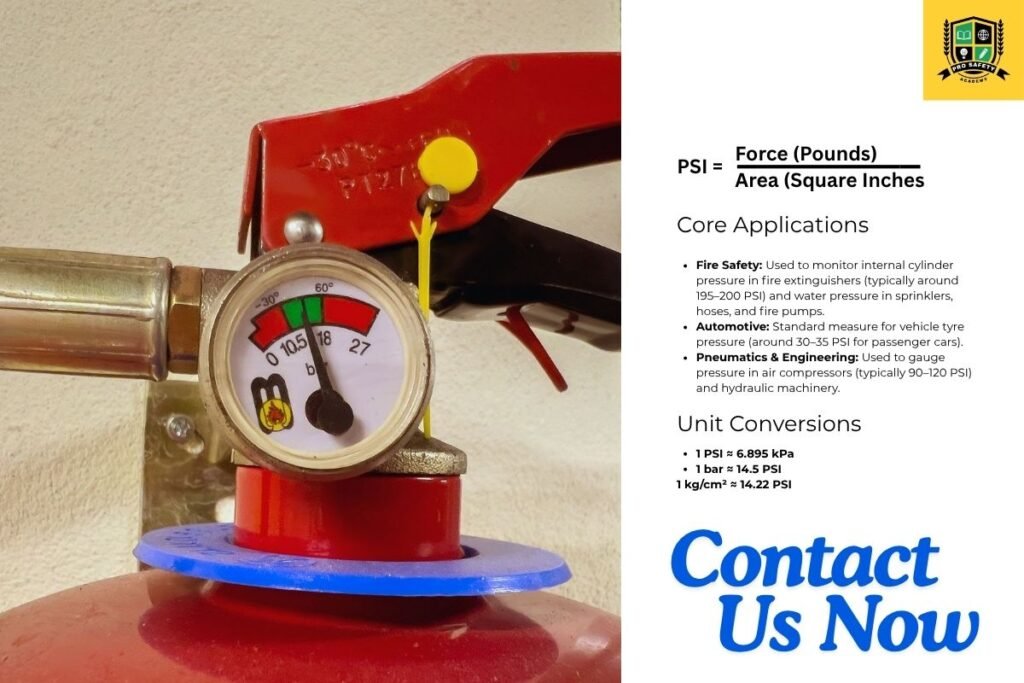
PSI can mean different things depending on the context. In safety, fire safety, and engineering, PSI usually means:
PSI = Pounds per Square Inch
It is a unit of pressure used to measure the force exerted over an area.
Example:
- Fire extinguisher pressure: 200 PSI
- Air compressor pressure: 100 PSI
- Tyre pressure: 32 PSI
1 PSI means 1 pound of force applied over 1 square inch of area.
Common conversion
1 PSI ≈ 6.895 kPa
1 bar ≈ 14.5 PSI
1 kg/cm² ≈ 14.22 PSI
For fire safety, PSI is commonly used for fire extinguisher cylinders, fire pumps, hoses, and pressurized systems.
Important Safety Note
A nozzle alone does not make a fire response safe. Flow rate, pump pressure, hose diameter, available water supply, foam compatibility, wind conditions, fire class and crew training all affect performance.
For example, a fog nozzle helps absorb heat through small droplets, whereas a smooth-bore stream generally offers greater reach and penetration.
For flammable – liquid hazards, use the foam type, foam proportioning equipment and application rate specified for the fuel and facility’s approved fire-protection plan.
Safety comes first
A nozzle is only as effective as the training, maintenance and firefighting strategy behind it. Equipment should be inspected regularly, operated by trained personnel and selected according to the hazards at the scene.
Choosing the correct fire hose nozzle improves firefighting efficiency, cooling, fire control and firefighter safety.
🔥 Start Your Fire Safety Career
Want to build practical knowledge of fire prevention, firefighting equipment, emergency response, and workplace fire safety?
Join Career ProSafety Academy’s Fire Safety Courses and develop the skills needed for a career in fire and safety management.
👉 Enquire Now | 📞 +91-7992430335 | 🌐 prosafetyacademy.com