A fire doesn’t give you time to read a manual. In those first few seconds, grabbing the wrong extinguisher can make things worse.
Water on an oil fire can spread flames. Water on a live electrical fire can cause a shock. Yet many people assume one red cylinder works for everything.
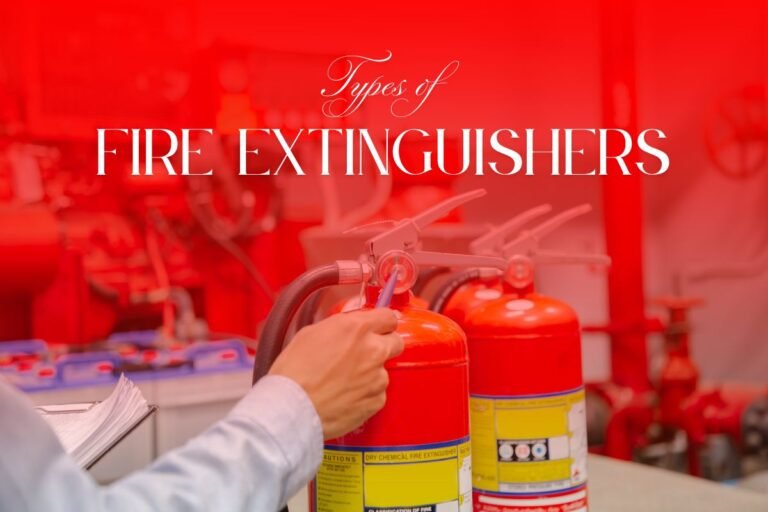
Let’s fix that. Here’s a simple guide to the main types of fire extinguisher and when to use each one.
First, Know Your Fire Classes
Extinguishers are chosen by the type of fire they fight. Fires are grouped into classes based on what’s burning.

| Class | What’s Burning | Examples |
|---|---|---|
| Class A | Ordinary solids | Wood, paper, cloth, plastic |
| Class B | Flammable liquids | Petrol, diesel, paint, solvents |
| Class C | Flammable gases | LPG, methane, propane |
| Class D | Combustible metals | Magnesium, aluminium, sodium |
| Class F (K in the US) | Cooking oils and fats | Deep fat fryers, kitchen oil |
| Electrical | Live electrical equipment | Panels, wiring, appliances |
Classification systems differ slightly between countries. Electrical fires are treated as a hazard type in some systems rather than a separate class. Always follow your local standard.
Classes of fire are defined in EN 2 as follows:
Class A: fires involving solid materials, usually of an organic nature, in which combustion normally
takes place with the formation of glowing embers;
Class B: fires involving liquids or liquefiable solids;
Class C: fires involving gases;
Class D: fires involving metals;
Class F: fires involving cooking media (vegetable or animal oils and fats) in cooking appliances.
1. Water Extinguisher
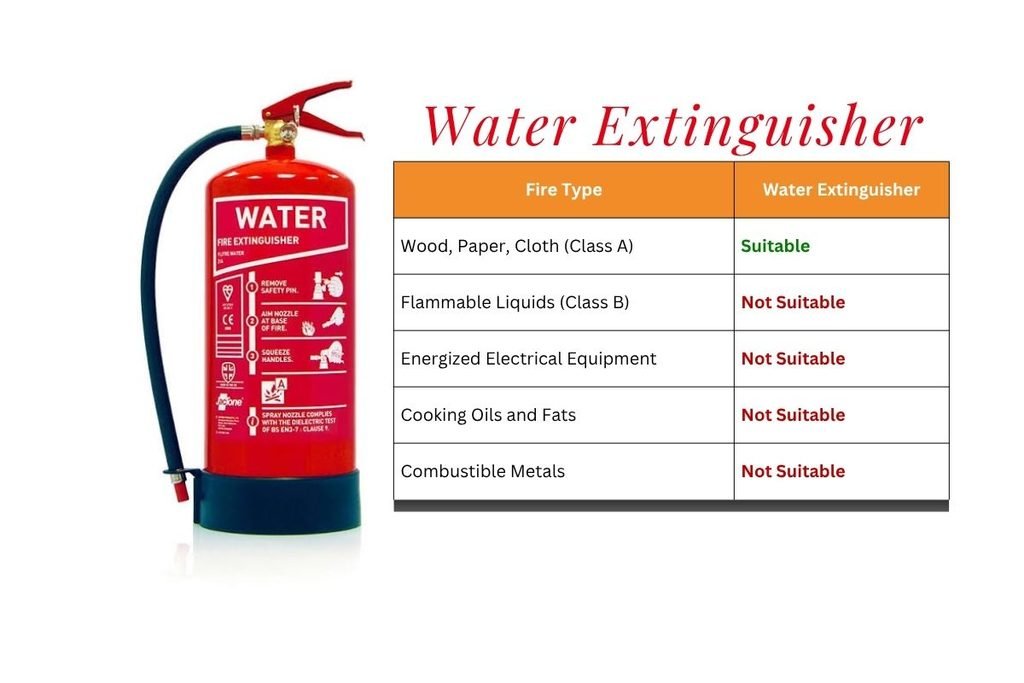
Water is the simplest and most common extinguisher. It works by cooling the fire and removing heat.
Best for: Class A fires like paper, wood, and cloth.
Never use on:
- Flammable liquid fires, since water can spread burning liquid
- Live electrical equipment, since water conducts electricity
- Cooking oil fires, since water can cause violent flare-ups
Where you’ll find it: Offices, schools, warehouses, and homes with mostly ordinary materials.
2. Foam Extinguisher
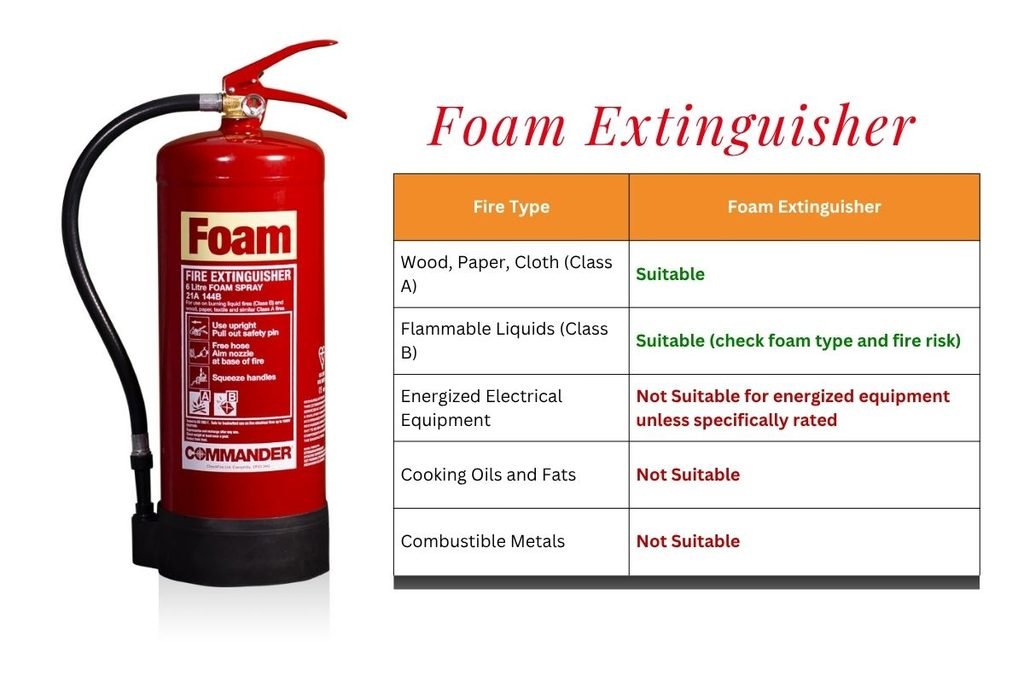
Foam forms a blanket over the fire. It cools the surface and cuts off the oxygen supply.
Best for: Class A and Class B fires, such as wood, paper, petrol, and paint.
Be careful with: Live electrical equipment. Foam contains water, so it isn’t suitable for energized equipment.
Where you’ll find it: Garages, fuel storage areas, workshops, and factories handling liquids.
3. CO2 (Carbon Dioxide) Extinguisher
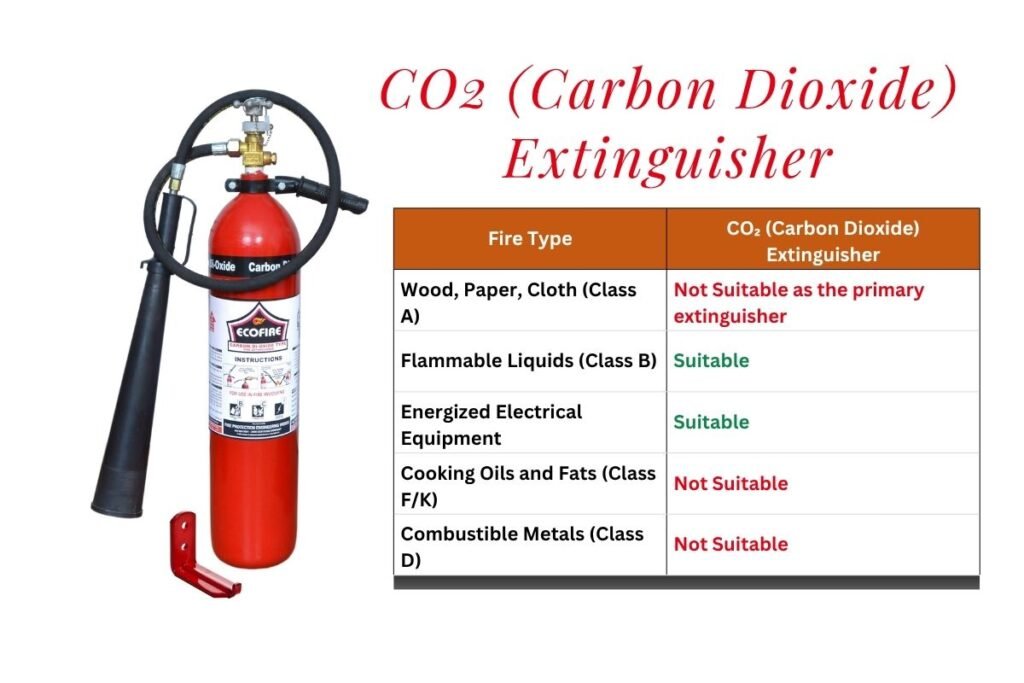
CO2 extinguishers release a cold gas that pushes oxygen away from the fire. They leave no residue behind.
Best for: Electrical fires and small Class B fires.
Safety points:
- The discharge horn gets extremely cold, so don’t hold it with bare hands
- In small closed rooms, CO2 can reduce oxygen, so ventilate the area afterward
- It has limited effect on deep-seated Class A fires, which can reignite
Where you’ll find it: Server rooms, electrical panels, laboratories, and offices with lots of equipment.
4. Dry Powder Extinguisher
Dry powder smothers the fire and interrupts the chemical reaction that keeps it burning. It’s one of the most versatile options.
Common types:
- ABC powder: Works on Class A, B, and C fires
- BC powder: Works on Class B and C fires
- Special powder: Made for Class D metal fires
Best for: Mixed-risk areas such as vehicles, fuel stations, and industrial sites.
Things to keep in mind:
- Powder can reduce visibility when discharged
- It can be messy and may damage sensitive electronics
- Avoid using it in small enclosed spaces, because inhaling the powder is harmful
- Standard ABC powder is not suitable for metal fires, so use the special Class D type
Where you’ll find it: Vehicles, petrol pumps, plants, boiler rooms, and workshops.
5. Wet Chemical Extinguisher
Wet chemical extinguishers spray a fine mist of liquid that cools the fire and forms a soapy layer over the oil. This stops it from reigniting.
Best for: Class F (K) fires involving cooking oils and fats. It can also work on Class A fires.
Never use on: Live electrical equipment.
Where you’ll find it: Commercial kitchens, canteens, restaurants, and food courts.
If you’ve seen a kitchen fire go wrong with water, you’ll understand why this extinguisher matters.
6. Clean Agent Extinguisher
Clean agent extinguishers use gaseous or vaporizing agents that put out fire without leaving residue. They’re built to protect valuable equipment.
Best for: Electrical equipment, electronics, and small Class B fires. Some types also handle Class A.
Why people choose them:
- No messy residue to clean up
- Safe for sensitive electronics
- Suitable for areas with expensive equipment
Things to know:
- They cost more than other types
- Some agents have environmental restrictions, so check what’s allowed locally
- Ensure ventilation after use in closed rooms
Where you’ll find it: Data centers, control rooms, museums, archives, and telecom rooms.
Quick Comparison Table
| Extinguisher | Class A | Class B | Class C | Class D | Class F (K) | Live Electrical |
|---|---|---|---|---|---|---|
| Water | ✅ | ❌ | ❌ | ❌ | ❌ | ❌ |
| Foam | ✅ | ✅ | ❌ | ❌ | ❌ | ❌ |
| CO2 | ⚠️ Limited | ✅ | ❌ | ❌ | ❌ | ✅ |
| Dry Powder (ABC) | ✅ | ✅ | ✅ | ❌ | ❌ | ✅ |
| Wet Chemical | ✅ | ❌ | ❌ | ❌ | ✅ | ❌ |
| Clean Agent | ⚠️ Some types | ✅ | ⚠️ Some types | ❌ | ❌ | ✅ |
This table is a general guide. Always read the label on the actual extinguisher, because capabilities depend on the specific product and standard.
Colour Coding: A Quick Note
Many extinguishers use colour bands or labels to show what’s inside. The exact scheme varies by country and standard.
Under the common European system, the body is red with a coloured band showing the agent. For example, water is red, foam is cream, CO2 is black, dry powder is blue, and wet chemical is yellow.
Rules differ elsewhere, so never rely on colour alone. Read the label and the pictograms on the cylinder.
How to Use an Extinguisher: The PASS Method
Remember the word PASS in a small fire:
- Pull the safety pin
- Aim the nozzle at the base of the fire
- Squeeze the handle
- Sweep from side to side across the base
Only fight a fire if it’s small, you have a clear exit behind you, and you’ve been trained. If the fire grows or fills the room with smoke, leave and call the fire service.
Common Mistakes to Avoid
- Using water on oil, fuel, or electrical fires
- Grabbing an extinguisher without checking its label
- Placing extinguishers behind boxes or locked doors
- Skipping regular inspections and servicing
- Ignoring the pressure gauge or expired service tags
- Attempting to fight a large fire instead of evacuating
- Having no training on how to use the equipment
Placement and Maintenance Tips
Extinguishers only help if you can reach them fast.
- Mount them in visible, accessible locations along exit routes
- Match the type to the main risk in each area
- Check pressure gauges and seals regularly
- Arrange professional servicing as required by local rules
- Replace or refill extinguishers after any use, even partial
- Train staff, and run hands-on practice sessions
Compare this with the US NFPA system
Class A is essentially the same in India and the US NFPA system: ordinary solid combustibles such as wood, paper, cloth, rubber and many plastics. The important difference is Class C: gases in India, energized electrical equipment in the US.
Indian vs US NFPA classification
| Burning material or hazard | Indian system | US NFPA system |
|---|---|---|
| Ordinary solid combustibles—wood, paper, cloth, many plastics | Class A | Class A |
| Flammable liquids—petrol, solvents, petroleum oils | Class B | Class B |
| Flammable gases—LPG, propane, methane | Class C | Class B |
| Combustible metals—magnesium, sodium, etc. | Class D | Class D |
| Cooking oils and fats in cooking appliances | Class F | Class K |
| Energized electrical equipment | No separate lettered fire class; electrical safety is an additional requirement | Class C |
Indian classifications are reflected in Indian Railways’ fire-classification guidance; US classifications follow NFPA’s published definitions.
Why this matters for extinguishers
- An “ABC” label does not mean exactly the same thing across systems. In India, C refers to gas fires; under NFPA, C indicates suitability for fires involving energized electrical equipment. Do not infer electrical suitability from an Indian Class C designation alone—check the extinguisher’s electrical-use marking and instructions.
- Under NFPA, electrical Class C applies while equipment remains energized. Once de-energized, the underlying burning material determines the fire class—for example, Class A for burning solid insulation.
Memory aid: India separates gases into C; the US puts gases in B and reserves C for energized electrical equipment.
Final Thoughts
There’s no single extinguisher that fits every fire. The right choice depends on what’s burning and where you are.
Learn the fire classes, know where your extinguishers are, and read their labels before you ever need them. A few minutes of preparation today can stop a small fire from becoming a disaster tomorrow.
Frequently Asked Questions
A dry powder ABC extinguisher is a popular all-rounder. For kitchens, a wet chemical or a suitable fire blanket adds extra protection.
No. Water conducts electricity and can cause shock. Use CO2, dry powder, or clean agent instead.
Foam, dry powder, or CO2 are commonly used for flammable liquid fires. Never use water.
CO2 or clean agent extinguishers suit server rooms, since they leave little or no residue.
Both suit electrical fires. CO2 displaces oxygen and gets very cold, while clean agents interrupt the fire chemically and are often chosen for delicate equipment.
Cooking oil burns at very high temperatures and can reignite. Wet chemical cools the oil and forms a layer that prevents it from reigniting.
Follow your local fire safety rules and the manufacturer’s guidance. Do quick visual checks regularly and arrange professional servicing on schedule.