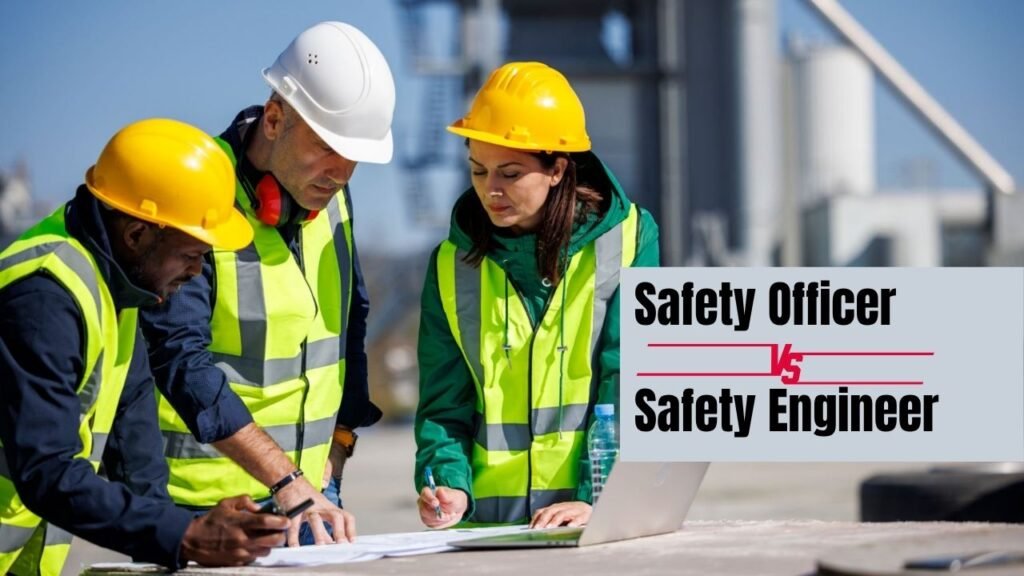
If you’re exploring a career in workplace safety, you’ve probably come across two job titles that sound almost identical. Safety Officer and Safety Engineer get mixed up all the time, even by people already working in the field.
You might be wondering if they’re just two names for the same job. Spoiler alert: they’re not. Let’s clear up the confusion once and for all.
Who Is a Safety Officer?
A Safety Officer is your on-ground guardian of workplace safety. You’ll find them walking through factories, construction sites, and offices every single day.
Their main job is monitoring daily operations to ensure everyone follows safety rules. They conduct regular inspections, spot hazards, and report unsafe practices immediately.
Safety Officers also handle emergency drills and train employees on safety protocols. You’ll often see them checking fire extinguishers, first-aid kits, and evacuation routes.
Documentation is a big part of their role too. They maintain safety records, incident reports, and compliance checklists constantly.
Most Safety Officers hold a diploma or certificate course in fire and safety management. You don’t necessarily need an engineering background to become one.
This role suits people who enjoy hands-on, practical work over deep technical design. If you like being active and interacting with people daily, this fits you well.
Who Is a Safety Engineer?
A Safety Engineer, on the other hand, works more behind the scenes. Their focus leans heavily toward designing safer systems, processes, and equipment.
You’ll find Safety Engineers analyzing potential hazards before they even happen. They use technical knowledge to predict risks during the design and planning stages.
This role often involves creating safety protocols for entire projects or facilities. They also evaluate equipment, machinery, and infrastructure for potential design flaws.
Safety Engineers typically hold an engineering degree, often in industrial or mechanical fields. Some pursue specialized degrees in safety engineering itself.
Their work is more analytical and technical compared to a Safety Officer’s daily fieldwork. If you enjoy problem-solving through design and data, this role suits you better.
Key Differences Between Safety Officer and Safety Engineer
Let’s break down the core differences so things become crystal clear.
| Point | Safety Officer | Safety Engineer |
|---|---|---|
| Main Focus | Daily workplace safety and compliance | Designing safer systems and processes |
| Education | Safety diploma/certification | Engineering degree |
| Work Type | Practical and field-based | Technical and analytical |
| Key Responsibility | Inspections, PPE, training, hazard reporting | Risk analysis, engineering controls, system design |
| Workplace | Mostly on-site | Office + site/design work |
| Technical Knowledge | Basic to moderate | Advanced engineering knowledge |
| Career Entry | Generally quicker through safety qualifications | Requires longer engineering education |
| Best For | People who enjoy fieldwork and supervision | People who enjoy engineering and technical problem-solving |
Educational Background: Safety Officers usually need a diploma or certification in fire and safety. Safety Engineers require a formal engineering degree, often with specialization.
Nature of Work: Safety Officers focus on daily monitoring, inspections, and enforcement. Safety Engineers focus on designing safer systems and preventing hazards structurally.
Work Environment: Safety Officers spend most of their time on-site, actively supervising operations. Safety Engineers split their time between site visits and technical planning work.
Scope of Responsibility: Safety Officers manage day-to-day compliance and immediate risk response. Safety Engineers manage long-term safety strategy and system-level improvements.
Career Entry Point: You can become a Safety Officer right after 12th through short courses. Becoming a Safety Engineer usually requires a full engineering degree first.
Salary Range: Safety Officers typically start with moderate salaries that grow with experience. Safety Engineers often start higher due to their advanced technical qualifications.
Which Career Path Should You Choose?
This really depends on your interests, strengths, and how much time you want to invest.
If you love quick entry into the workforce and enjoy fieldwork, become a Safety Officer. You’ll start working sooner and gain practical experience immediately.
If you’re drawn to technical problem-solving and don’t mind a longer educational path, consider Safety Engineering. You’ll work on bigger-picture solutions that prevent hazards before they occur.
Both roles are genuinely important, and honestly, they work best together. Safety Officers implement daily safety measures, while Safety Engineers design the systems behind them.
Neither role is “better” than the other. They simply serve different purposes within the same larger mission: keeping people safe.
Final Thoughts
So there you have it, the real difference between a Safety Officer and a Safety Engineer. One handles daily operations on-site, while the other designs safer systems from the ground up.
Your choice ultimately depends on how you want to build your career. Whether you pick the practical route or the technical one, both paths lead somewhere meaningful.
Workplace safety needs both roles to function properly, and honestly, that’s a good thing. So pick the path that excites you, and know you’re stepping into a career that genuinely matters.
FAQ’s
No, they’re different roles. A Safety Officer handles daily on-site monitoring, while a Safety Engineer focuses on designing safer systems and processes.
Safety Engineers generally earn more starting out due to their engineering degree. However, experienced Safety Officers can also earn competitive salaries over time.
No, most Safety Officer roles only require a diploma or certificate course. An engineering background isn’t mandatory for this position.
Yes, but you’d typically need to pursue a formal engineering degree first. Some professionals do transition between these roles with additional qualifications.
Both roles enjoy strong job security due to strict safety regulations. Industries like construction, manufacturing, and oil constantly need both positions filled.
Safety Engineers usually hold a degree in industrial, mechanical, or safety engineering. Some also pursue additional certifications like NEBOSH or IOSH.
Yes, many fire and safety courses accept students immediately after 12th. This makes it a quicker entry point compared to engineering degrees.
Absolutely, they often collaborate closely on projects. Safety Officers implement daily protocols that Safety Engineers help design and structure.
Safety Officers spend most of their time actively on-site conducting inspections. Safety Engineers split their time between fieldwork and technical planning.
Choose Safety Officer if you want quicker entry and hands-on daily work. Choose Safety Engineer if you enjoy technical design and don’t mind a longer study path.