Walk into any safety shop and you’ll see a wall of boots, shoes, and strange codes like S1P and S3. It’s easy to feel lost.
Here’s the good news. Safety shoes fall into a few clear groups. Once you know them, picking the right pair gets much easier.
Let’s go through the main types of safety shoes, what each one does, and where it works best.
Types of Safety Shoes by Toe Cap
The toe cap is the first thing most people think about. It protects your toes from falling or rolling objects.
- Steel Toe Shoes
These have a steel cap built into the front. They’re strong, affordable, and widely available.
Best for: Construction, heavy manufacturing, warehouses, and sites where heavy items could drop.
Keep in mind: They’re heavier than other options. Steel also conducts heat and cold, which can feel uncomfortable in extreme weather.
- Composite Toe Shoes
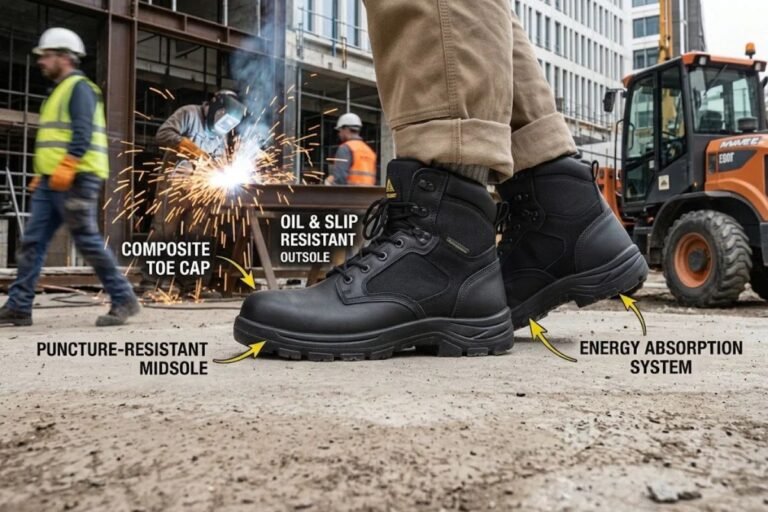
Composite caps use materials like plastic, carbon fibre, or fibreglass. They give similar protection without the metal.
Best for: Workers who walk a lot, work in hot or cold areas, or pass through metal detectors.
Keep in mind: They’re often lighter, but they can cost more and may be a bit bulkier at the toe.
- Aluminium Toe Shoes
Aluminium caps are lighter than steel while still offering solid protection.
Best for: Workers who want a lighter shoe without giving up a metal cap.
- Soft Toe Shoes
These have no protective toe cap. They give general comfort and some sole protection, but they don’t protect against heavy impact.
Best for: Low-risk tasks where toe injury isn’t a concern. Don’t use them where objects could fall on your feet.
Types of Safety Shoes by Protective Feature
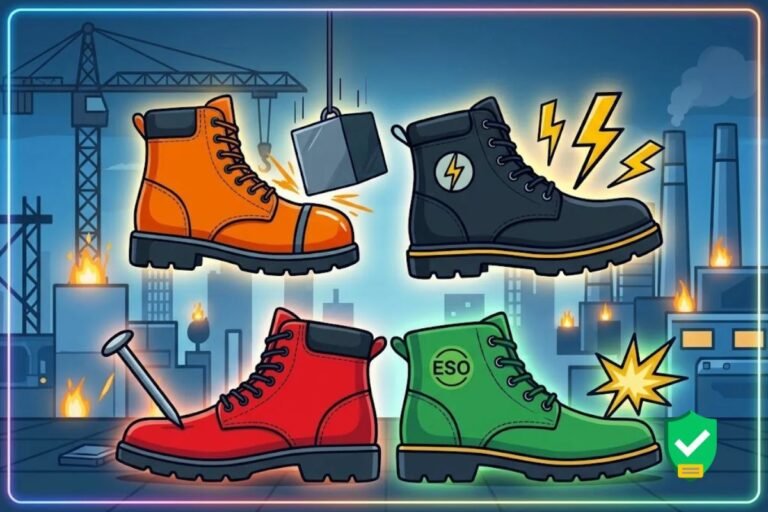
Beyond the toe cap, shoes are built to handle specific hazards.
- Slip-Resistant Safety Shoes
These have outsoles with special tread patterns and rubber compounds. They grip wet, oily, or smooth floors.
Best for: Kitchens, workshops, food plants, and anywhere with spills.
- Puncture-Resistant Safety Shoes
A protective plate sits in the midsole. It stops nails, screws, and sharp debris from reaching your foot.
Best for: Construction sites, demolition, scrap yards, and any place with sharp items on the ground.
- Metatarsal Guard Shoes
These add extra protection over the top of your foot, called the metatarsal area. It’s the part that toe caps don’t cover.
Best for: Heavy handling, foundries, and jobs where something could land across your foot.
- Electrical Hazard (EH) Shoes
These shoes have non-conductive soles and heels. They add a layer of protection against accidental contact with live circuits.
Best for: Electricians, utility workers, and maintenance teams.
Keep in mind: They’re a backup layer, not a replacement for proper electrical safety procedures. Wet or damaged soles reduce their effectiveness.
- Static Dissipative (SD) and Anti-Static Shoes
These safety shoes help drain static electricity safely to the ground. They reduce the build-up of static charge in your body.
Best for: Electronics assembly, cleanrooms, and areas with sensitive equipment.
- Conductive Safety Shoes
These work the opposite way of EH shoes. They let static electricity pass quickly to the ground to reduce the risk of sparks.
Best for: Places with explosive or flammable materials, where a static spark could cause a fire. Never wear them around live electrical work.
- Heat-Resistant Safety Shoes
These use soles and materials that handle high surface temperatures and splashes of hot material.
Best for: Foundries, welding, metal work, and hot surface environments.
- Chemical-Resistant Safety Shoes
They use materials such as rubber or special polymers that resist certain chemicals and liquids.
Best for: Chemical plants, laboratories, cleaning operations, and agriculture.
Keep in mind: No material resists every chemical. Check the manufacturer’s information against the substances you handle.
- Waterproof and Insulated Safety Shoes
Waterproof shoes keep your feet dry, and insulated ones add warmth.
Best for: Wet sites, cold storage, outdoor winter work, and rainy construction conditions.
Types of Safety Shoes by Style
14. Safety Shoes (Low-Cut)
These look like regular work shoes or sneakers. They’re light and comfortable.
Best for: Warehouses, factories, and light-to-medium risk jobs where you move around a lot.
- Safety Boots
Boots cover your ankles and provide more support.
Best for: Construction, uneven ground, and tasks that need ankle protection.
- Safety Gumboots (Wellingtons)
These are tall, waterproof boots made from rubber or PVC. Many include steel toe caps.
Best for: Wet areas, mines, food processing, drainage, and chemical cleaning.
- Safety Sandals and Clogs
These offer a lighter, more open design with a protective toe cap in some models.
Best for: Hot environments, labs, or light industrial settings where the risk is low and the rules allow open styles. Check your site rules first, because many sites prohibit open footwear.
Understanding Safety Ratings on the Label
Many safety shoes carry codes that show what they protect against. You’ll often see these under the EN ISO 20345 standard.
| Code | What It Generally Means |
|---|---|
| SB | Basic safety footwear with a protective toe cap. |
| S1 | Includes SB features, plus a closed heel, antistatic properties, and energy absorption in the heel. |
| S1P | Includes all S1 features, plus a puncture-resistant midsole. |
| S2 | Includes all S1 features, plus resistance to water penetration and water absorption by the upper material. |
| S3 | Includes S2 features, plus a puncture-resistant midsole and a cleated outsole. |
You might also see slip-resistance marks such as SRA, SRB, or SRC. In India, look for markings that refer to IS 15298. In the US, you’ll see ASTM F2413 labels.
Standards and markings can change, so read the label and the manufacturer’s information on the exact pair you buy.
Quick Guide: Which Type for Which Job?
| Job or Hazard | Suitable Type |
|---|---|
| Construction Site | Steel-toe or composite-toe safety boots with puncture-resistant midsoles. |
| Warehouse | Lightweight safety shoes with slip-resistant outsoles. |
| Electrical Work | Electrically rated safety footwear appropriate for the specific electrical hazards. |
| Electronics Assembly | Static-dissipative footwear to help control electrostatic discharge (ESD). |
| Flammable or Explosive Areas | Conductive or antistatic footwear, as required by the site’s hazardous-area assessment. |
| Welding and Foundry | Heat-resistant safety boots with metatarsal protection and suitable protection against sparks and molten-metal splashes. |
| Chemical Handling | Chemical-resistant safety boots compatible with the chemicals being handled. |
| Wet or Muddy Areas | Waterproof safety gumboots with slip-resistant soles. |
| Cold Storage | Insulated safety boots designed for low-temperature environments. |
| Kitchens and Food Plants | Slip-resistant safety shoes suitable for wet or greasy floors and the site’s hygiene requirements. |
Tips for Choosing the Right Type
- Start with the hazard. List what could hurt your feet on your job.
- Match the feature to the risk. Toe cap, puncture plate, and sole type each handle different dangers.
- Check the label and standard. Don’t rely on looks.
- Get the fit right. Try shoes on in the afternoon, wearing your work socks.
- Think about comfort. Cushioned insoles and breathable lining help during long shifts.
- Replace damaged pairs. Cracked soles or exposed toe caps no longer protect you.
Final Thoughts
There’s no single best safety shoe. The right type depends on your job, your hazards, and your comfort.
Know the hazards first, match the features next, and always read the label. A well-chosen pair protects your feet every single shift.
Frequently Asked Questions
They are commonly grouped by toe cap (steel, composite, aluminium, soft toe), by feature (slip-resistant, puncture-resistant, electrical hazard, and so on), and by style (shoes, boots, gumboots).
Steel toe caps are strong and affordable but heavier and conduct heat and cold. Composite toe caps are lighter and don’t conduct heat or cold as much, but they can cost more.
They are categories under EN ISO 20345. S1 is a basic safety shoe with extra features, S1P adds puncture resistance, S2 adds water resistance, and S3 adds both puncture resistance and a cleated sole.
Safety boots with a steel or composite toe cap, a puncture-resistant midsole, and a slip-resistant outsole suit most construction work.
No. They are a secondary layer of protection. You still need proper electrical safety procedures and correct PPE.
Anti-static shoes allow static to drain slowly, while conductive shoes drain it faster. Each suits different environments, and conductive shoes must not be used near live electrical work.
Only if your site rules and risk assessment allow it. Many sites require fully enclosed footwear.
Replace them when you see damage, heavy wear, or exposed toe caps, or after a heavy impact. Follow the manufacturer’s guidance.