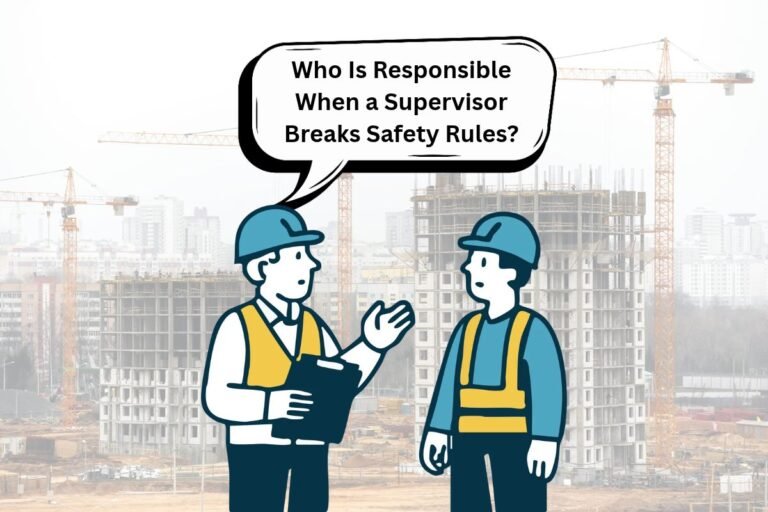
When a supervisor breaks safety rules, responsibility is usually shared between the supervisor, the employer, and management. Here’s who is accountable, what the OSH Code says, and how to prevent it.
The main intro opens with a short scene, names the question in the title, and tells readers what the article covers. If you’d rather start with a more emotional, story-style opening, I can write that version instead.
The Short Answer
Responsibility is usually shared. The supervisor is accountable for their own decisions, and the employer is accountable for the system that allowed it. Workers, managers, and contractors can also carry part of it, depending on what they knew and did.
A company can’t simply blame the supervisor and walk away. Safety law in most countries puts the main duty on the employer, and a supervisor’s actions often reflect pressure, training, and culture that the organization created.
1. The Supervisor
A supervisor has a direct role in daily safety. They assign tasks, check conditions, and set the tone on the shift.
So when a supervisor knowingly ignores a rule, they’re personally accountable. This includes things like:
- Skipping a permit to work or a pre-job check
- Allowing work without required PPE
- Overriding a safety device or lockout
- Telling workers to continue in unsafe conditions
- Ignoring reports of hazards or near misses
A supervisor can face disciplinary action, loss of authority, and in serious cases legal consequences. “My manager wanted it done fast” explains the pressure, but it doesn’t remove personal responsibility.
2. The Employer or Company
The employer holds the primary legal duty to provide a safe workplace. This doesn’t disappear because a supervisor made a bad call.
An employer is expected to provide:
- Safe systems of work and clear procedures
- Proper training and competent supervision
- Enough time, staff, and resources to work safely
- Monitoring, inspections, and audits
- Action when rules are broken
If a supervisor breaks rules repeatedly and nobody notices or acts, that points to a failure in the employer’s system. Regulators and investigators look at this closely.
3. Senior Management
Managers and leaders set the real priorities. If targets reward speed and ignore safety, supervisors feel pushed to cut corners.
Senior management is responsible when:
- Production pressure is unrealistic
- Safety budgets and staffing are too low
- Past violations were tolerated or rewarded
- Warnings from safety staff were ignored
Culture starts at the top. A supervisor who breaks rules is often copying what the organization quietly allows.
4. Workers
Workers aren’t just bystanders. Most safety laws give them duties too, such as following safe procedures, using PPE, and not endangering themselves or others.
That doesn’t mean workers must carry the blame for a supervisor’s order. It does mean they should:
- Raise concerns about unsafe instructions
- Use stop-work authority if their workplace provides it
- Report hazards and near misses
- Not take part in clearly dangerous shortcuts when they have a safe option
Workers often feel stuck, especially when jobs or pay are at risk. That’s why employers must make it safe to speak up.
5. Contractors and Principal Employers
On sites with contractors, responsibility can sit with more than one party. A principal employer may share duties for site safety, and the contractor holds duties for their own workers.
When a contractor’s supervisor breaks a rule, investigators often ask: who controlled the site, who gave the instruction, and who failed to check?
What the Law Says in India
India’s Occupational Safety, Health and Working Conditions Code, 2020 (the OSH Code) sets out duties for employers and employees. The employer’s duties are in Section 6, and the employee’s duties are in Section 13, according to published summaries of the Code. It also has provisions on offences by employees and offences by companies, which deal with who can be held liable.
The Code provides graded penalties, and serious accidents attract higher ones. Government notification of the Code was reported in late 2025, so check current rules and any state rules that apply to you.
In practice, this means:
- The employer carries the main statutory duty
- Employees, which can include supervisors, also have duties and can be held liable for their own offences
- Companies can be held liable, and individuals in charge may also face consequences depending on their role and what they knew
This is general information, not legal advice. Responsibility in a real case depends on the facts, the exact laws that apply, and the findings of an investigation. For a specific incident, consult a qualified lawyer or your legal team.
Why Do Supervisors Break Safety Rules?
Understanding why helps you prevent it. Common reasons include:
- Production pressure: Deadlines and targets push people to cut corners
- Normalization: “We’ve always done it this way and nothing happened”
- Weak training: The supervisor doesn’t fully understand the risk
- Poor role models: Their own managers skip rules
- Lack of consequences: Past violations were ignored
- Resource gaps: Not enough people, time, or equipment
- Overconfidence: Experience makes them underestimate the danger
Notice that most of these are system problems, not just personal ones.
What Happens After an Incident?
A good investigation doesn’t stop at “the supervisor broke the rule.” It asks deeper questions.
- What exactly happened, and what rule was broken?
- Why did the supervisor make that choice?
- Did the system allow or encourage it?
- What did managers know beforehand?
- Were workers trained and able to speak up?
- What fixes will stop it from happening again?
This is root cause analysis. Disciplinary action may still be appropriate, but it shouldn’t replace fixing the underlying causes.
How Employers Can Prevent Supervisors Breaking Safety Rules
- Train supervisors properly, including their legal and moral duties
- Set realistic targets that leave room for safe work
- Lead by example, starting at senior level
- Enforce rules consistently, regardless of rank
- Check the work: Do site inspections, audits, and spot checks
- Give stop-work authority and protect those who use it
- Create safe reporting channels, including anonymous ones
- Reward safe behavior, not only output
- Review near misses and learn from them
What Workers Can Do If a Supervisor Gives an Unsafe Order
If you face this, you have options. Follow your company’s procedure and local rules.
- Pause and ask. Raise the concern calmly and clearly.
- Use stop-work authority if your workplace offers it.
- Report it to the safety officer, a manager above the supervisor, or a safety committee.
- Write down what happened, including time, place, and instructions.
- Escalate to HR, a union, or the relevant authority if the issue isn’t resolved.
Never put your life at risk to avoid an awkward conversation. A safe worker is worth more than a finished task.
Final Thoughts
When a supervisor breaks safety rules, responsibility rarely rests on one person. The supervisor answers for their choices, and the employer answers for the system and culture behind them.
The best response isn’t just finding someone to blame. It’s fixing the training, pressure, and oversight that let the shortcut happen, so the next crew goes home safe.
Frequently Asked Questions
Usually both can be. The supervisor is accountable for their own actions, while the company is responsible for its systems, training, and oversight.
Yes. Depending on the case, this can include disciplinary action, and in serious cases legal consequences under local laws.
Not entirely. The employer holds the main duty for safety, and investigators look at whether the company’s systems allowed the violation.
Workers also have duties to work safely. They should raise concerns and use stop-work authority where possible, but responsibility will depend on the facts of the case.
It’s the right of any worker to pause a job that looks unsafe, without fear of punishment, until the concern is checked.
Both the principal employer and the contractor can hold duties. Investigators look at who controlled the site and who gave the instruction.
No. It may explain why it happened, and it can shift some responsibility to management, but it doesn’t make rule-breaking acceptable.
Document it, raise it with senior management, enforce stop-work where authorized, and push for corrective action and retraining.