
What Is DFESM & Why It’s a Smart Career Move in 2026
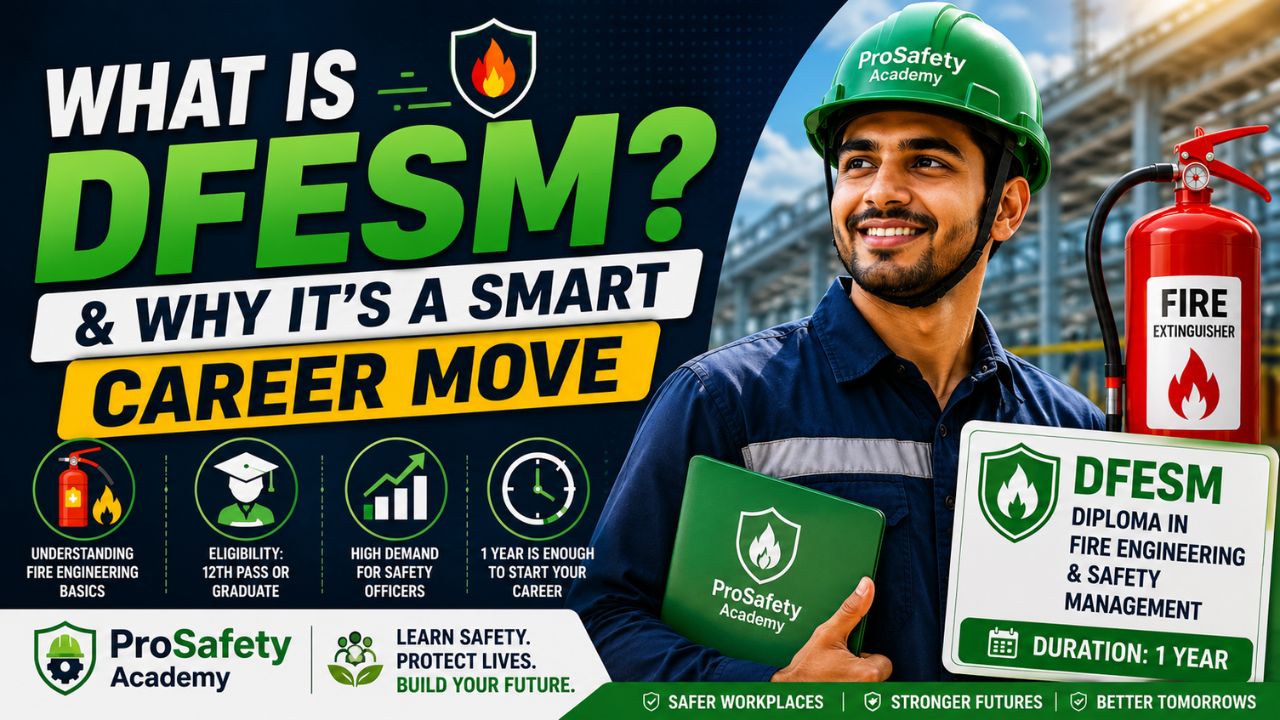
Choosing the right career can feel confusing. You may see hundreds of courses promising great jobs and bright futures. However, not every course gives you practical skills that employers truly value. That is why many students are exploring DFESM (Diploma in Fire Engineering and Safety Management). It combines technical knowledge with real-world safety practices. You learn how to prevent accidents, protect lives, and create safer workplaces.
The best part is that you do not need years of study to begin. If you have completed your 12th standard or graduated in any specialization, you can usually apply. This makes the course suitable for many students who want a professional qualification without spending several years in college.
Whether you’re just school pass out or already holding a any degree, DFESM can be your gateway to a rewarding and meaningful career. Let’s break it all down for you
| Subject Name | Subject Code | Max Marks | Passing Marks |
|---|---|---|---|
| Communicative English and Computer Fundamentals | FSS013-01 | 100 | 40 |
| Accident Prevention & Risk Management | FSS013-02 | 100 | 40 |
| Fire Hydraulics and Fire Loss Control | FSS013-03 | 100 | 40 |
| Safety in Electrical Systems | FSS013-04 | 100 | 40 |
| Safety & Prevention in Chemical & Oil Rigs | FSS013-05 | 100 | 40 |
| Fire Prevention & Control | FSS013-06 | 100 | 40 |
| Practical | FSS013-07 | 600 | 240 |
| Total | 1200 |
Understanding Fire Engineering Basics
Fire engineering is much more than learning how to use a fire extinguisher. It is the science of preventing fires, reducing risks, and protecting people and property. Every office, factory, shopping mall, hospital, and construction site needs proper fire safety planning.
During DFESM (Diploma in Fire Engineering and Safety Management), you learn how fire starts and spreads. You also understand different types of fire hazards and the safest ways to control them. These lessons help you recognize risks before they become dangerous.
You also study emergency response planning. This includes evacuation methods, fire detection systems, alarm systems, and rescue procedures. These skills prepare you for real workplace situations where quick thinking matters.
Another important part of the course is industrial safety. You learn how to identify unsafe conditions, inspect workplaces, and recommend improvements. These practical skills make you valuable to many employers.
Safety professionals also understand national safety regulations and workplace standards. Learning these rules helps you support organizations in creating safer environments. Instead of reacting after accidents happen, you learn how to prevent them from happening.
You will also become familiar with personal protective equipment, commonly called PPE. Knowing when and how to use safety equipment reduces workplace injuries and increases confidence on the job.
As your knowledge grows, you begin thinking like a safety professional. You notice risks that many people overlook. This ability becomes one of your strongest career advantages.
Eligibility Is Simple for Many Students
| Eligibility Point | In Short |
|---|---|
| 12th Pass | ✅ Yes |
| Graduation (Any stream) | ✅ Yes |
| Science background mandatory? | ❌ No |
| Entrance test needed? | ❌ Usually not |
| Entrance test needed? | ❌ No |
| Entrance test needed? | ✅ Yes |
Many career courses have strict admission requirements. Some demand specific academic subjects or high entrance scores. Fortunately, DFESM (Diploma in Fire Engineering and Safety Management) is much more accessible.
In many institutes, students who have completed their 12th standard can apply. Graduates from any specialization are also eligible Like BA, BSc, B. Tech and BE. This opens the door for student from science, commerce, and arts backgrounds.
You do not always need previous experience in engineering. The course starts with basic concepts and gradually introduces advanced topics. This learning approach makes it easier for beginners to understand technical subjects.
If you enjoy practical learning more than memorizing theory, this course may suit your learning style. Classroom sessions are often supported by demonstrations, safety equipment training, and practical exercises.
Many students worry that they are changing careers too late. Fortunately, safety management welcomes learners from different educational backgrounds. Your willingness to learn often matters more than your previous field of study.
Because the eligibility requirements are straightforward, you can focus on building skills instead of worrying about complicated admission conditions.
Growing Demand for Safety Officers
| Category | Category |
|---|---|
| Industries Hiring DFESM Graduates | Construction & Infrastructure – sites, metro, high-rises Oil, Gas & Petrochemical – refineries, offshore, NEOM projects Manufacturing & Industrial Plants – factories, chemical plants EPC Projects – Engineering, Procurement & Construction (major contractors) Power & Renewable Energy – solar/wind farms, substations Healthcare & Pharma – hospitals, labs with strict compliance Logistics, Warehousing & Supply Chain Aviation & Airports Facilities Management – malls, corporate campuses |
| Average Salary in India | Freshers typically start around ₹2.5 LPA to ₹4.5 LPA, with experienced professionals earning ₹6 LPA to ₹10 LPA |
| 💡 Salary Abroad (Gulf Region) | Highest paying: Qatar (up to ₹1.25 Lakh/month) and Saudi Arabia (up to ₹1.20 Lakh/month) Most accessible for freshers: UAE and Dubai offer the lowest entry barriers (AED 2,500+) Tax-free advantage: Compare these figures to Indian salaries – a ₹1 Lakh tax-free salary is equivalent to earning ~₹1.4 Lakh in India (pre-tax) Growth potential: With 3–5 years of experience, salaries can double or triple, especially in oil & gas and mega-projects (NEOM, Expo sites, etc.) |
| Key Opportunities in the Gulf | High Demand: UAE, Saudi Arabia, and Qatar are massive employers due to mega-projects (NEOM, infrastructure, stadiums) and the oil & gas sector . Hiring Industries: Construction, Oil & Gas, and EPC sectors have the highest demand for certified safety officers . Why Them? Strict compliance laws and high-risk environments make trained professionals a legal necessity . |
Workplace safety has become a major priority across many industries. Company understand that preventing accident protects employees, reduces financial losses, and improves business performance.
As industries continue expanding, the demand for trained safety professionals also continues growing. Manufacturing plants, construction companies, logistics firms, hospitals, airports, educational institutions, hotels, and energy companies all require qualified safety personnel.
A safety officer performs many important responsibilities. You may inspect workplaces, conduct safety audits, organize emergency drills, train employees, investigate incidents, and recommend preventive measures.
Governments and industry regulators also encourage organizations to follow strict safety standards. Because of these expectations, employers increasingly seek candidates with specialized safety education.
The skills you gain through DFESM (Diploma in Fire Engineering and Safety Management) match the practical needs of many workplaces. Instead of learning only theoretical concepts, you develop abilities that employers can use immediately.
Safety careers also offer variety. Some professionals work at construction sites. Others join manufacturing plants, corporate offices, oil and gas companies, educational institutions, or healthcare facilities. This flexibility allows you to explore different industries throughout your career.
As businesses continue investing in employee safety, skilled professionals are likely to remain valuable in the employment market.
Why One Year Can Make a Big Difference
Many students hesitate before joining a diploma because they wonder whether one year is enough. The answer depends on what you learn during that time.
A focused one-year program teaches practical knowledge without unnecessary delays. Instead of spending several years studying unrelated subjects, you concentrate on industry-relevant skills.
During the course, you build technical understanding, practical confidence, and professional awareness. You learn safety procedures, emergency planning, risk assessment, workplace inspections, and accident prevention techniques.
These abilities prepare you for entry-level opportunities soon after completing your training. You can also continue learning through certifications and workplace experience as your career grows.
A one-year course also allows you to enter the workforce earlier. This means you begin gaining practical experience while others may still be completing longer academic programs.
Every workplace values professionals who can identify risks before problems occur. Employers appreciate candidates who understand safety procedures and communicate clearly with teams.
If you are looking for a practical career with meaningful responsibilities, DFESM (Diploma in Fire Engineering and Safety Management) offers a strong starting point. You gain useful skills, improve your employability, and prepare yourself for opportunities across multiple industries.
Choosing the right course is an investment in your future. When you select a program that develops practical knowledge and workplace confidence, you create a foundation for long-term career growth.